


Snails in linen bags collected from the walls of St Leonard's chapel in Brittany. Worn around the neck as a cure for fever, they were buried at the foot of the walls of the chapel as soon as the fever had passed. It was believed that if the wearer failed to perform this ceremony, their fever would return. |
Policeman's amulet, France. Acquired in Paris in 1889, this amulet is made from a coin, a piece of hangman's rope and skin from a sadistic murderer named Campi. Campi reportedly murdered one Monsieur Ducros de Sixt in the Rue du Regard on 10th August 1883 and was sentenced to death. In the 189th century many people believed that the rope from which a criminal had been hanged had curative powers and could bring good luck. On execution days people would congregate around the gallows in order to be cured by a 'death stroke' from the dead man's hand. |
 |
Horned hands, Italy. Horned hands we worn as protection against the harmful glance of the Evil Eye. Sparkling and brightly coloured, their striking appearance was thought to divert attention away from the wearer so that she or he could escape unharmed. Belief in the Evil Eye - the power of certain animal and people to inflict malady on anything they look at - continues to be held in many parts of the world. |
 |
Skulls, Italy. These 'death's head' amulets from Naples were used to decorate rosaries and to remind people of the transience of life. The white ones are made of shell, while the brown coloured ones are made of lava from Mount Vesuvius. |
 |
| Carved and decorated sheep bone, to protect against scorpions |
 |
| Crocodile eggs used to carry poison |
 |
| Tiger's tooth on which an oath has been taken |
 |
| Sealed bottle, said to contain a witch |
 |
| Cast brass hand amulet against the Evil Eye. Fixed to the saddle of a cab-horses's harness |


 |
| This fella was sat on the fence for about an hour... |
 |
| ...whilst Lebowski and I watched from the window |
 |
| When I opened the back door to get a closer look, he turned... |
 |
| ... and did a poo down me fence! |
 |
Then flew off and sat on the neighbour's roofSome pigeons at The Natural History Museum |
 |
| Darwin's pigeons |
 |
| nice bird |
 |
| similar bird |
 |
| dead bird in a book |
 |
| Not a pigeon |
 |
| Not a pigeon, not a bird |
 |
| Bag full of earth with pins inserted. To cure a fever. |
 |
| Bag in which prey God fetishes are hung round the neck when on a hunting expedition |
 |
| Moulded Buddha reputed to contain ashes of a deceased Lama, and stamped with the seal of a monastery |
 |
| Intriguing drawing, unsure as to what the ground is. Fabric, paper, leather? |
 |
| Interesting bag knitted with thread, containing a fish-like amulet |
 |
| Hunting amulet |
 |
| Icons inside leather 'purse' looks hand made. |

 |
| Teeth and claws |
 |
| Tooth and bone necklace worn to cure disease and illness |
 |
| One of the many curious drawers at the museum |
 |
| Natural objects stabbed with nails and wrapped with thread |
 |
| Nuts used to hang in a boat for good luck |
 |
| Seal charm |


 |
| A cure for warts |
 |
| Young child, silver |
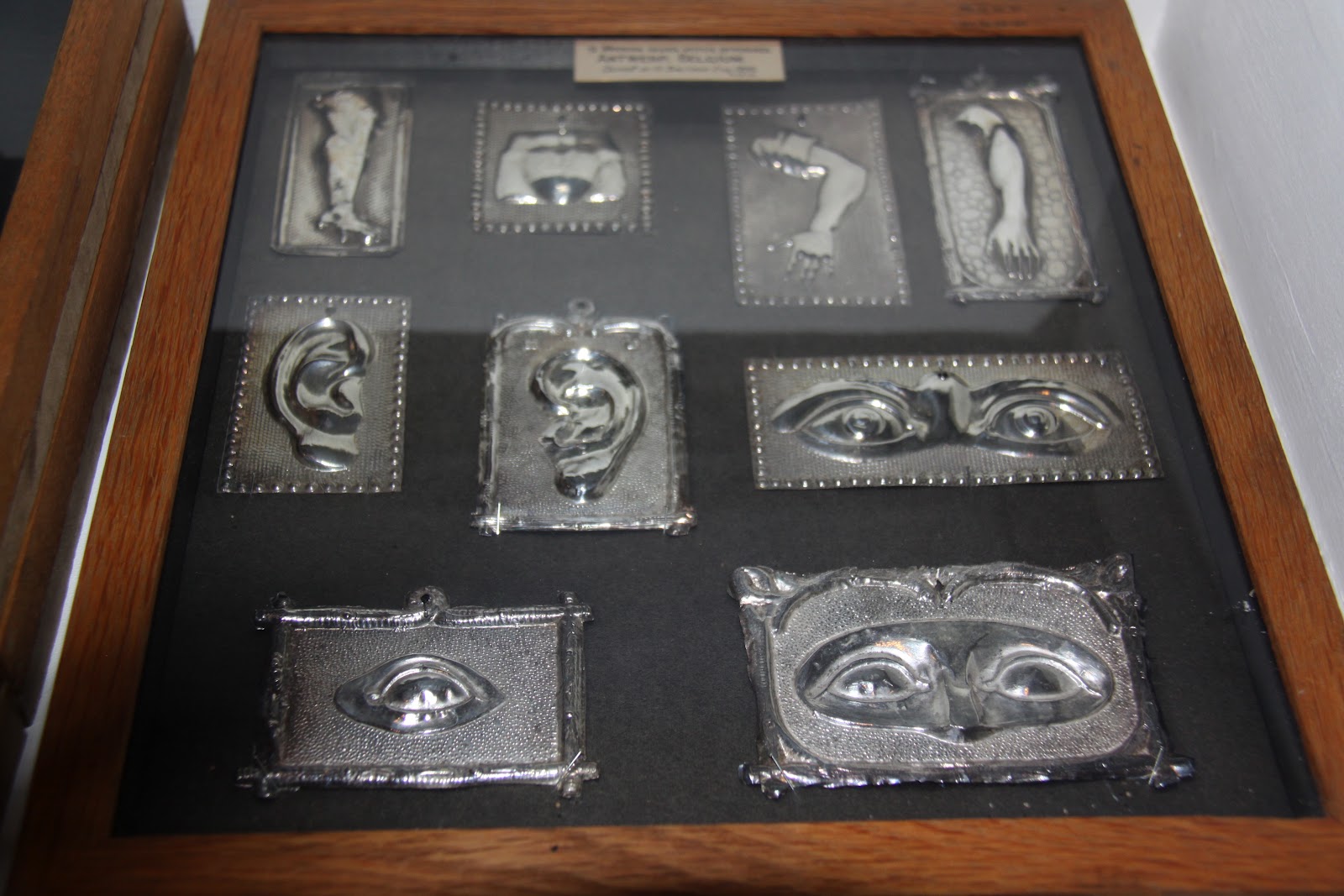 |
| Box of silver body parts, used as votives if the person has an ailment with that particular part of their body |
 | ||
| View through one of the cabinets |
 |
| cow, silver |
 |
| Case displaying labelled metal amulets and votives |
 |
| Eye votive |
 |
| Figures of a boy and girl, clay |
 |
| Clay and plaster moulds and casts |
 | |
| Mould for the goat |
 |
| Various casts from clay, wax and wood |
 |
| Wax goat with mould |
 |
| Body part votives used as offerings for medical conditions |


